
💻 No hype. No price calls. Just honest analysis from an operator mining since 2019.
▪ Review the free guide if you’re reassessing your mining setup.
▪ Subscribe for free to get new insights in your inbox.
📑 Table of Contents
1. Introduction
2. Fee Market Reality
3. The Bull Case: Bitcoin as Settlement, Not Payments
4. The Bear Case: What If Layer 2 Doesn’t Deliver?
5. Why Cheaper Chains Aren’t Real Substitutes
6. Why I Keep Mining
🟠 Introduction
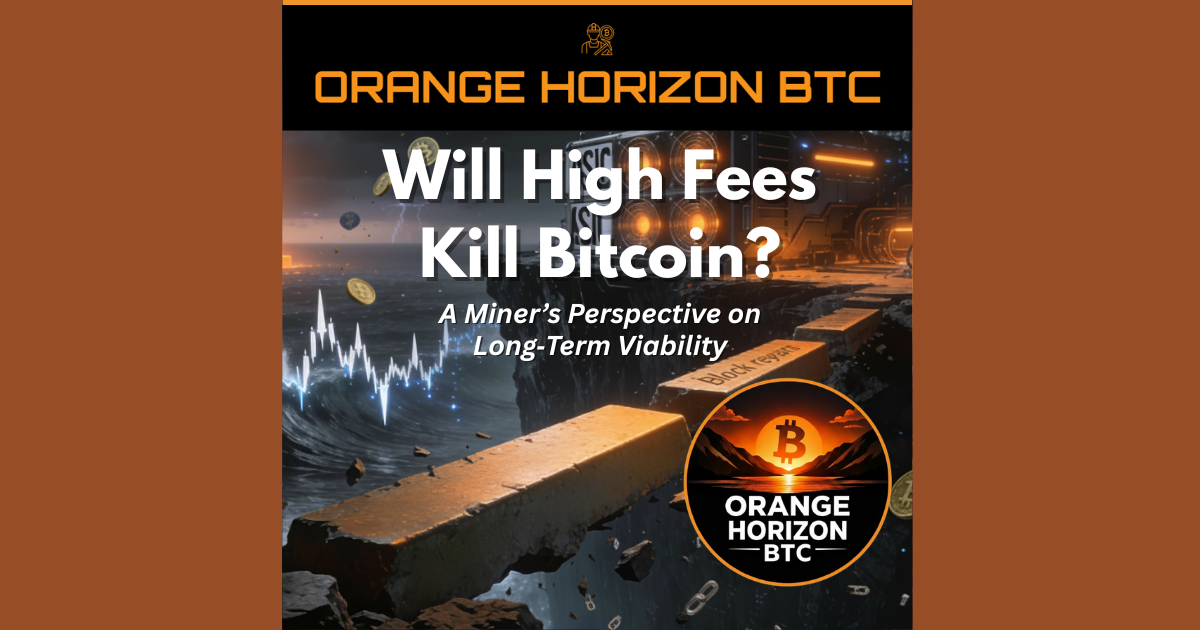
I’ve been mining Bitcoin since December 2019. Six years of watching blocks confirm, difficulty adjust, and fee markets swing from pennies to triple digits has given me a front row seat to one of Bitcoin’s most important unanswered questions:
🔎 What happens when the block subsidy runs out?
Every four years, the halving cuts miner revenue from newly issued coins in half. Today, miners earn 3.125 BTC per block. In 2028, that drops to 1.5625 BTC. By 2140, it goes to zero. From that point forward, transaction fees alone must sustain the network.
If miners aren’t profitable, hashrate falls. If hashrate falls, security weakens. And if security weakens, Bitcoin’s entire value proposition collapses.
That’s the dilemma that keeps me up at night. As transaction fees become the primary source of miner revenue, those fees will need to rise. Both in satoshi terms and, if Bitcoin’s price continues climbing, in dollar terms. At some point, sending a Bitcoin transaction could cost $50, $100, or more during congestion.
When that happens, why wouldn’t users switch to Litecoin, XRP, or some other chain that can move money across borders for a fraction of the cost?
It’s a fair question. And if you’re holding Bitcoin as a long term bet, you should be asking it too.
🟠 Fee Market Reality
Bitcoin’s security model depends on miners being paid for their work. Early on, block subsidies covered this entirely, miners were effectively compensated through inflation. But Satoshi hard capped the supply at 21 million coins, ensuring that inflation trends toward zero over time. The economic assumption was always that transaction fees would eventually replace block rewards.
The problem is that we don’t yet know whether fee revenue can scale to match declining subsidies.
We’ve seen previews. During periods of intense block space demand (most recently during the Ordinals and NFT activity) fees spiked dramatically. Transactions became expensive, exchanges paused withdrawals, and opening Lightning channels grew costly. It was a glimpse of what a fee dominant Bitcoin might look like, and for everyday users, it wasn’t pleasant.
You can argue those spikes were driven by speculative excess. Maybe they were. But they revealed something important: when demand for block space exceeds supply, fees don’t rise gently, they surge. And as long as block space remains constrained to roughly 4 MB every ten minutes, fee pressure is structural, not accidental.
So if you’re a regular person trying to send $500 internationally and Bitcoin charges $75 in fees, why wouldn’t you use Litecoin for 50 cents? Or XRP for fractions of a cent?
What actually stops that migration?
🟠 The Bull Case: Bitcoin as Settlement, Not Payments
This is where Bitcoin maximalists have a legitimate point.
Bitcoin is not trying to be Venmo. It isn’t competing with Visa or PayPal for everyday retail transactions. It’s competing with centralbank wires, correspondent banking networks, and physical gold transfers. Systems designed to move large amounts of value with finality.
In that world, fees are secondary. Security is everything.
If you’re moving $10 million, do you care if the transaction costs $500? Of course not. What matters is that the transfer is irreversible, censorship resistant, and backed by enough computational power that no government, corporation, or cartel can undo it.
🔎 Current SHA-256 Algorithm Network Speed
Bitcoin currently operates at over 1.1 zetahashes per second of hashrate. Litecoin secures roughly 2.4 petahashes using Scrypt. XRP doesn’t mine at all. It relies on a federated validator model heavily influenced by Ripple Labs.
Bitcoin’s fee premium isn’t a flaw. It’s the price of absolute settlement finality.

When institutions like BlackRock move billions into Bitcoin ETFs, they aren’t doing it because transactions are cheap. They’re doing it because Bitcoin is the only digital asset with the security budget, decentralization, and regulatory clarity to function as a global monetary base layer.
Under this model, Bitcoin’s base layer becomes settlement infrastructure for high‑value transfers. Retail users rarely touch it directly. Instead, they transact on second‑layer systems like the Lightning Network, which batch thousands of payments off‑chain and settle periodically on Bitcoin itself.
High Layer 1 fees don’t kill Bitcoin under this framework, they justify it. They signal that block space is scarce, valuable, and secured at enormous cost.
And there’s real logic here. The entities buying Bitcoin today care far more about counterparty risk, capital controls, and monetary debasement than about transaction fees. Bitcoin solves those problems. Litecoin does not.
🟠 The Bear Case: What If Layer 2 Doesn’t Deliver?
The settlement layer thesis, however, depends entirely on Layer 2 working well. And today, it’s still rough.
I’ve used Lightning. When it works, it’s impressive. But it’s also fragile. Users must manage channel liquidity, understand routing, and either run their own infrastructure or trust custodians, reintroducing the very counterparty risk Bitcoin was designed to remove.
For most people, Lightning is too complex. And if users rely on custodial Lightning wallets from apps like Cash App or Strike, they aren’t really using Bitcoin, they’re trusting a company that promises to settle in Bitcoin later.
That’s a serious problem. If average users can’t self‑custody on Layer 2, Bitcoin’s promise of censorship resistant money weakens. You end up swapping banks for fintech firms.
There’s also the deeper issue of long‑term security. Today, miners are sustained primarily by block subsidies. But consider 2040, when subsidies fall below 0.1 BTC per block. If fee revenue hasn’t scaled sufficiently, miners begin shutting off machines. Hashrate declines. Security weakens.
At that point, the core argument for Bitcoin (that it’s the most secure network on Earth) starts to crack.
This is the scenario few people like to discuss: a slow security erosion where declining subsidies lead to miner capitulation, lower hashrate, institutional retreat, price decline, and further miner exits. A feedback loop.
Do I think this outcome is likely? No. But is it possible? Absolutely. Anyone holding Bitcoin for decades should understand that risk.
🟠 Why Cheaper Chains Aren’t Real Substitutes
The “just use a cheaper chain” argument only works if those chains offer comparable guarantees.
🔎 Litecoin
Litecoin has existed since 2011. In more than a decade, it has achieved minimal institutional adoption, limited developer momentum, and weak network effects. Its hashrate (around 2.4 petahashes) is trivial compared to Bitcoin’s 1.1+ zetahashes. A determined attacker could realistically 51% attack Litecoin. That’s inconceivable with Bitcoin.
Litecoin is cheaper because it’s less valuable, not because it’s superior.
🔎 XRP
XRP fares even worse as a comparison. It uses no Proof‑of‑Work at all, relies on a permissioned validator model, and remains closely tied to Ripple Labs, which controls a large share of the supply. It’s designed for banks, not for neutral, censorship resistant money. Whatever XRP is, it isn’t Bitcoin.

So when people ask why users won’t migrate en masse to cheaper alternatives, the answer is simple: those alternatives don’t provide the same assurances.
| Network | Hashrate | Algorithm | Security |
| Bitcoin | 1.1+ ZH/s | SHA-256 | Institutional‑grade |
| Litecoin | 2.4 PH/s | Scrypt | Vulnerable |
| XRP | None | Validators | Centralized |
Sovereign wealth funds and public company treasuries don’t deploy billions into second best security models. They choose the asset that is hardest to seize, censor, or corrupt. Today, that asset is Bitcoin.
🟠 Why I Keep Mining
I don’t know whether Bitcoin’s fee market will fully sustain miner revenue over the very long term. No one does. We’re still less than two percent through Bitcoin’s issuance schedule. The real stress test is decades away.
What I do know is this: Bitcoin has survived every existential threat it has faced exchange collapses, regulatory crackdowns, mining bans, civil wars over scaling, and endless declarations of death.
Each time, the same principle has held: the system that is hardest to kill ultimately attracts the most capital.
Bitcoin remains that system. As long as institutions, governments, and individuals value censorship‑resistant settlement over cheap transactions, the fee market will find equilibrium.
Could I be wrong? Of course. Maybe Layer 2 stagnates. Maybe security degrades in the 2040s. Maybe some future protocol solves decentralization, scalability, and trust simultaneously.
But I doubt it.
Bitcoin’s network effects are enormous. Its security budget, over 1.1 zetahashes per second, is unmatched. Institutional integration is already deep. And the core reality hasn’t changed: moving serious wealth requires serious security.
🔎 So will high fees kill Bitcoin?
I don’t think so. But they will force Bitcoin to become what it was always meant to be: a final settlement layer for value that matters. Not a coffee payment network. Not a Venmo replacement.
A monetary base layer where security costs money, and where that cost is worth paying.
If that isn’t the Bitcoin you want, there are plenty of cheaper chains available.
Just don’t be surprised when they fail to hold value the way Bitcoin does.
In the end, you get what you pay for.
Want to go deeper on the variables behind these numbers?
1️⃣ Read The Bitcoin Miner’s Guide to Transaction Fees for how fees actually work and what miners earn from them.
2️⃣ Read Lightning Network Explained for a full breakdown of Bitcoin’s Layer 2 scaling solution.
3️⃣ Read Mining Economics 101 for the full profitability framework.
▶️ Looking to upgrade your operation? Altair Technology, ASIC Marketplace, and OneMiners carry the hardware serious miners are actually running.
▶️ Need ASIC accessories? Amazon is a reliable source for surge protection, power cables, and other essentials that keep your operation running safely.
▶️ Need a hardware wallet? The Tangem wallet is a simple, card-format option for self-custody. Use code GPEBZY for 10% off.
▶️ New to mining? Here’s a hands-on guide to mining Bitcoin at home — from choosing hardware to realistic expectations for your first month.

testygrip17@walletofsatoshi.com

bc1qazjvrmdxv5d4xr482z72a6ev39du893lsakw0u
✅ Follow along on my socials:
🟠 X: @OrngeHorizonBTC
🔵 Bluesky: @orngehorizonbtc.bsky.social
🌐 Website: orangehorizonbtc.com


Leave a Reply