
💻 No hype. No price calls. Just honest analysis from an operator mining since 2019.
▪ Review the free guide if you’re reassessing your mining setup.
▪ Subscribe for free to get new insights in your inbox.
⚠️ Note: This analysis references Bitcoin’s price (for mining purposes), network difficulty, and hashprice as of mid-March 2026. These figures change constantly — verify current data before making any decisions.
📑 Table of Contents
1. Introduction
2. The Difficulty Snapshot
3. The Price Snapshot
4. The Accumulation Window
5. What This Does Not Mean
6. Conclusion
🟠 Introduction
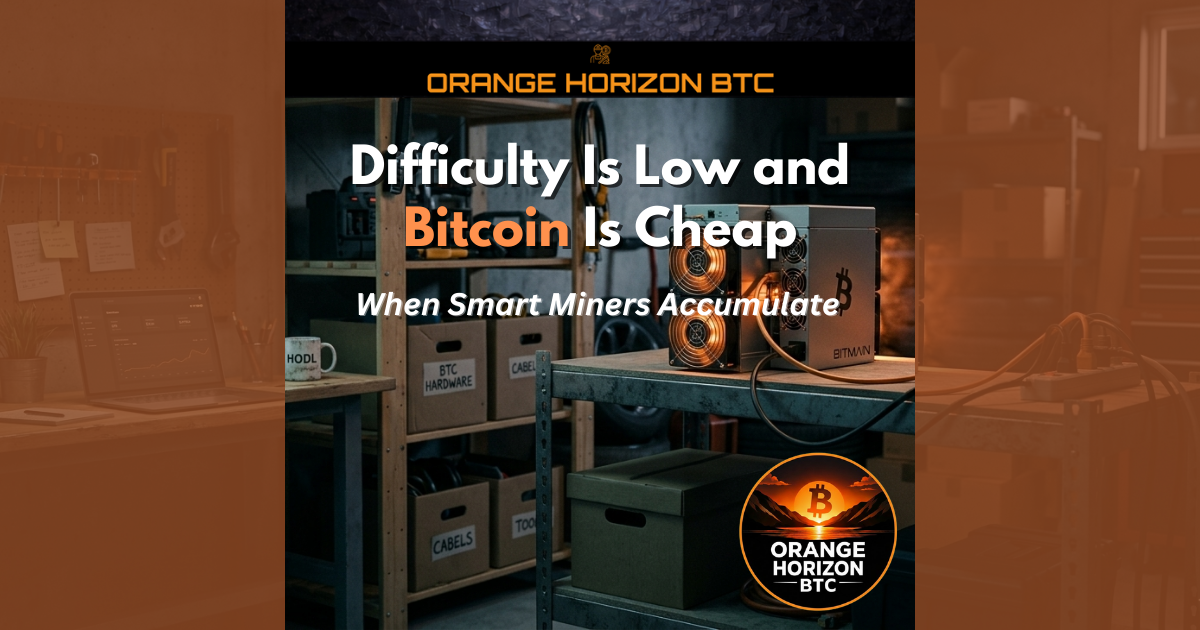
This is not a popular opinion right now, but it needs to be said. If you are a home miner sitting on thin margins or even running at a slight loss, you may be in a better position than you think. Not because the numbers look good today — they do not for a lot of operators. But because today’s numbers are a snapshot, not a verdict.
Bitcoin is trading around $70,500, well below its 2025 all-time high near $126,000. The latest difficulty adjustment on March 5 was a modest +0.45%, following a highly volatile stretch earlier in the year that included a major negative adjustment in February. Hashprice is hovering around $30 per petahash per day. For many home miners, that math lands somewhere between break-even and slightly underwater depending on electricity rates and hardware efficiency.
That feels discouraging. Some operators are turning machines off. Some are questioning whether they should have just bought Bitcoin instead. That reaction is understandable. It is also short-sighted.
🟠 The Difficulty Snapshot
Network difficulty is one of the most misunderstood variables in mining. Miners tend to look at it as a fixed obstacle — the higher it goes, the harder it gets, the less you earn. That framing is technically correct on any given day, but it becomes misleading over a longer time horizon.
Right now, estimated network hashrate sits in the range of roughly 980 to 1,020 EH/s depending on the source and averaging method. That sounds enormous, and it is. But every major halving cycle has been followed by substantial hashrate growth as new capital enters the industry, more efficient machines come online, and infrastructure expands globally. The hashrate that feels crushing today may look modest in hindsight if that pattern continues.
The miners who stayed online during the 2022 bear market (when Bitcoin fell below $16,000 and several large operators were under severe financial stress) were mining at difficulty levels that look far lower than today’s. In hindsight, those sats turned out to be some of the cheapest they ever accumulated. That does not guarantee the same outcome now, but it is a pattern worth understanding.

🟠 The Price Snapshot
Bitcoin at $70,500 does not feel cheap. But it is significantly below its 2025 peak, and whether it proves cheap from here depends on what Bitcoin does over the next cycle. Price is always relative to time horizon, not just to the last few months.
Every cycle in Bitcoin’s history has produced a new all-time high that made many earlier prices look inexpensive in hindsight. People who bought at $1,000 thought they were late. People who bought at $10,000 thought the same. People who bought at $30,000 during the 2022 crash were told they were catching a falling knife.
If Bitcoin reaches materially higher levels in the next cycle, then every sat mined at today’s difficulty and price could look remarkably cheap in hindsight. Not because mining was highly profitable in the moment, but because the asset appreciated faster than the cost of production. This is the part that daily profitability calculators cannot capture: they show you today’s margin, not the future purchasing power of the Bitcoin you are accumulating.
🟠 The Accumulation Window
Low-margin periods are where disciplined miners build positions. During bull runs, hardware sells out, hosting contracts fill up, and difficulty rises as fresh hashrate floods the network. By the time retail enthusiasm peaks, mining economics are often more compressed than they were during the quieter stretch that came before.
The operators who accumulate the most Bitcoin over a full cycle are usually not the ones who plug in at the top and ride the wave. They are the ones who stay online during the boring, uncomfortable months when everyone else is turning off machines or liquidating hardware. Right now, the network appears less like a boom and more like a reset: Bitcoin is well below its 2025 high, hashprice is low but not catastrophic, and many miners are operating under real pressure.
For home miners with reasonable electricity rates and relatively efficient hardware, this can still be accumulation season. It does not feel like it. It is not supposed to.

🟠 What This Does Not Mean
This is not a recommendation to mine at any cost. If your electricity rate is $0.15 per kWh and you are running S9s, the math is difficult to justify regardless of your time horizon. There is a difference between mining at a manageable loss with a credible long-term thesis and mining recklessly with no path to recovery.
The operators this applies to are the ones running reasonably current hardware (S19 XP to S21 or newer) at electricity rates in roughly the $0.06 to $0.10 range, and who have already absorbed most or all of their hardware cost. For those operators, the real question is not whether today looks attractive on a calculator. The question is whether the Bitcoin mined today will likely be worth meaningfully more than the electricity used to produce it.

🟠 Conclusion
Difficulty is low relative to where it may be heading if Bitcoin’s historical growth pattern continues. Bitcoin is meaningfully below its 2025 high. Yet many miners still judge a multi-year accumulation strategy through the lens of a daily profitability spreadsheet.
The miners who understand this are still plugged in, still stacking, and still running through the quiet stretch. They are not doing it because today’s numbers are exciting. They are doing it because they understand that Bitcoin accumulation through mining often looks least impressive in the moment it matters most.
Mining can feel dull in the present and powerful in hindsight. That is not a flaw in the strategy. That is the strategy.
Want to go deeper on the variables behind these numbers?
1️⃣ Read Mining Economics 101 for a full overview of the five variables that control profitability.
2️⃣ Read Dominant Variable Costs in Bitcoin Mining to understand what actually eats your margins.
3️⃣ See how operators respond when difficulty moves sharply in Bitcoin Mining Difficulty Just Whipsawed.
▶️ Looking to upgrade your operation? Altair Technology, ASIC Marketplace, and OneMiners carry the hardware serious miners are actually running.
▶️ Need ASIC accessories? Amazon is a reliable source for surge protection, power cables, and other essentials that keep your operation running safely.
▶️ Need a hardware wallet? The Tangem wallet is a simple, card-format option for self-custody. Use code GPEBZY for 10% off.
▶️ New to mining? Here’s a hands-on guide to mining Bitcoin at home — from choosing hardware to realistic expectations for your first month.

testygrip17@walletofsatoshi.com

bc1qazjvrmdxv5d4xr482z72a6ev39du893lsakw0u
✅ Follow along on my socials:
🟠 X: @OrngeHorizonBTC
🔵 Bluesky: @orngehorizonbtc.bsky.social
🌐 Website: orangehorizonbtc.com



Leave a Reply