
💻 No hype. No price calls. Just honest analysis from an operator mining since 2019.
▪ Review the free guide if you’re reassessing your mining setup.
▪ Subscribe for free to get new insights in your inbox.
📑 Table of Contents
1. Introduction
2. The 2026 Energy Landscape for Miners
3. The Economics of Solar Mining
4. Solar as a Hedge, Not a Statement
5. What “Green Mining” Means Now
6. Looking Toward 2030
🟠 Introduction
Bitcoin mining isn’t going green because miners suddenly found their conscience. It’s going green because the economics finally make sense.
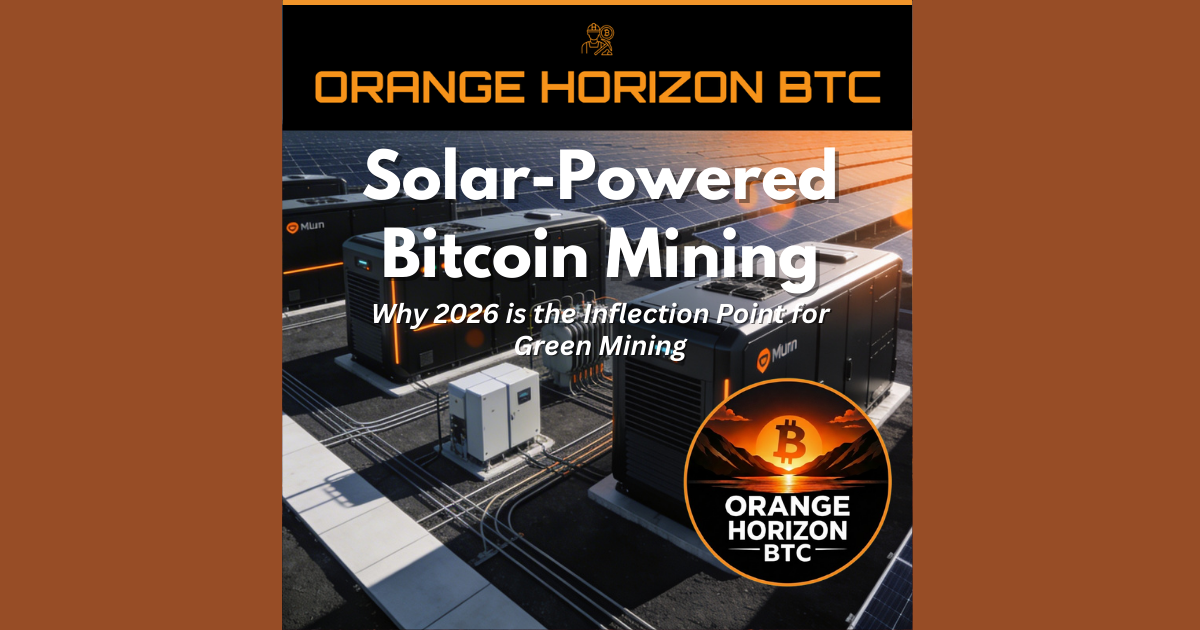
After six years running mining operations through multiple market cycles, I’ve watched electricity move from a secondary line item to the single biggest factor deciding whether you stay profitable or shut down. In 2026, solar power isn’t an ESG talking point. It’s becoming a legitimate strategic hedge. It lets miners lock in margins, reduce exposure to grid price volatility, and reposition themselves as grid balancing partners instead of energy villains.
☀️ Green Mining Narrative
The “green mining” narrative has changed. What started as defensive PR against environmental criticism has evolved into a structural shift in how mining operations source and manage power. Today, roughly 52–56% of Bitcoin’s global hashrate runs on sustainable energy (hydro, wind, solar, and nuclear) up from about one third in 2021. Solar still represents only 3–5% of the mix, but that share is growing quickly as installation costs fall and incentives expand.
This isn’t happening because miners became idealists. It’s happening because cheap, flexible solar power finally aligns with the brutal economics of post halving mining.
Operators who ignore that shift are leaving margin on the table.
🟠 The 2026 Energy Landscape for Miners

Here’s the reality check: Bitcoin mining in early 2026 is profitable, but barely, and only if two things are locked down. Efficient ASICs below ~25 J/TH, and electricity under $0.05 per kWh. Ideally under $0.04 if you want breathing room.
The 2024 halving cut block rewards in half. Price appreciation has kept many operations alive, but margin compression is real. Miners running older S19-class machines at 30+ J/TH are either upgrading to S21s and newer hardware or exiting entirely. Mining profitably on $0.08–0.10 grid power is no longer realistic for most operators.
At the same time, grid power isn’t getting cheaper. It’s getting more volatile. Wholesale markets now see frequent price spikes as grids struggle to balance intermittent renewables with demand. Events that used to happen a few times per year are monthly in some regions. For miners on spot pricing or variable contracts, that volatility is lethal.
Solar offers a way out, but only if you understand what it actually does, and what it doesn’t.
🟠 The Economics of Solar Mining
A solar installation sized for a small to mid scale mining operation (roughly 1–5 MW) typically breaks even in 3–5 years for DIY builds in favorable climates with decent incentives. Hosted or PPA-based models can reach positive cash flow in 1–2 years, depending on structure and grid offset.
The key point: solar mining is not about going fully off-grid. It’s about hybridization.
You generate enough solar to cover base load during peak sun hours, sell excess power back to the grid when prices are high, and draw from the grid at night or during low-rate periods. Done properly, this reduces your effective power cost without sacrificing uptime.
This is where the “Bitcoin as a buyer of renewables” argument actually holds up. Mining is a flexible, dispatchable load that can absorb excess generation that would otherwise be curtailed. Utilities and renewable developers increasingly want miners colocated with solar farms because guaranteed demand improves project economics and shortens payback periods.
A 1 MW solar build still requires serious capital, often around $1M to $3M or more depending on project type, location, and interconnection costs. Adding 4 to 6 hours of battery storage can add roughly another $500k to $2M or more, which is one reason most mining operations remain grid-connected instead of chasing full energy independence.
☀️ 2026 Solar Model
The realistic 2026 model looks like this: 40–60% of annual energy from solar, pulling your blended power cost down to roughly $0.02–0.04 per kWh when amortized over a 20–25 year system life. The remainder still comes from the grid, but drawn strategically during low-price windows.
🟠 Solar as a Hedge, Not a Statement

The real value of solar isn’t eliminating your power bill. It’s eliminating surprises.
A solar installation is effectively a 20-year electricity futures contract with a fixed strike price. Your upfront capex becomes insurance against rate hikes, contract rollovers, regulatory shifts, and grid stress events.
In deregulating markets or regions retiring dispatchable generation, peak prices can spike to $0.50–$1.00 per kWh during stress events. Pulling 1 MW during one of those windows costs $500–$1,000 per hour. Even modest solar and battery coverage lets you ride through those periods at near-zero marginal cost.
PPAs offer another path. A developer builds and operates the system, and you buy the output at a fixed rate for 15–25 years. In 2026, industrial PPAs typically price between $0.025–$0.045 per kWh. For miners paying $0.06–$0.08 on the grid, that’s immediate margin expansion with no upfront capital.
The trade off is commitment. If Bitcoin crashes or your operation shuts down, the PPA doesn’t disappear. Solar works when you’re building for longevity. It’s dangerous if you’re operating opportunistically.
🟠 What “Green Mining” Means Now
Solar is only one piece of the broader shift. Hydro, wind, flare gas capture, stranded energy, and even nuclear all play roles. The unifying theme is flexibility.

Mining hasn’t reduced its energy use (hashrate is higher than ever) but the composition has changed. Hydro dominates in the Pacific Northwest, Quebec and Manitoba, and Scandinavia. Wind is expanding in Texas and the Plains. Flare gas mining is scaling across oil regions.
Solar just happens to be the most visible. Panels on a roof are easier to explain than curtailment curves and dispatchable load. From a PR standpoint, that matters. Operationally, solar is simply one more tool for managing cost and risk.
The real shift in 2026 is that miners are increasingly treated as grid assets rather than parasitic loads. Demand response programs now pay miners to curtail during peaks or ramp up during oversupply. Mining becomes a dual revenue operation: Bitcoin production plus grid services.
☀️ What Actually Works
🔸 You own the land and facility with a 10+ year horizon.
🔸 Solar resource is strong, often around 4.5+ peak sun hours.
🔸 Favorable interconnection, net billing, or curtailment arrangements are available.
🔸 Capital or attractive PPAs are available.
🔸 Grid power is expensive enough, often above roughly $0.06/kWh, to make solar worth serious consideration.
☁️ It Doesn’t Make Sense When
🔸 You’re leasing short-term.
🔸 You are in weak solar geographies.
🔸 Interconnection is expensive, delayed, or blocked.
🔸 Capital is better spent on more efficient ASICs or electrical upgrades.
🔸 Grid power is already very cheap, such as roughly $0.03 to $0.04/kWh from hydro.
The hardest parts aren’t technical, they’re regulatory and social. Zoning, interconnection, tax treatment, and community perception can derail projects if ignored. Maintenance is manageable but non-zero. Budgeting 1–2% of install cost annually is realistic.
🟠 Looking Toward 2030
Bitcoin mining could reach 70%+ renewable penetration by 2030. Whether it does depends on continued cost declines, policy support, and Bitcoin remaining valuable enough to justify infrastructure investment.

What’s already clear is this: treating renewable energy as optional puts you at a growing disadvantage. Margins are thin, volatility is high, and regulatory scrutiny isn’t going away.
Solar mining in 2026 isn’t a stunt or an experiment. It’s becoming standard practice for operators who intend to survive multiple cycles.
The question isn’t whether mining goes green, it’s whether you secure the margin advantage before it becomes table stakes.
Want to go deeper on the variables behind these numbers?
1️⃣ Read Follow the Water for a look at how hydro power is shaping where mining happens globally.
2️⃣ Read Dominant Variable Costs in Bitcoin Mining to find out what actually eats away at your margins.
3️⃣ Read Mining Economics 101 for the full breakdown of what drives miner profitability.
▶️ Looking to upgrade your operation? Altair Technology, ASIC Marketplace, and OneMiners carry the hardware serious miners are actually running.
▶️ Need ASIC accessories? Amazon is a reliable source for surge protection, power cables, and other essentials that keep your operation running safely.
▶️ Need a hardware wallet? The Tangem wallet is a simple, card-format option for self-custody. Use code GPEBZY for 10% off.
▶️ New to mining? Here’s a hands-on guide to mining Bitcoin at home — from choosing hardware to realistic expectations for your first month.

testygrip17@walletofsatoshi.com

bc1qazjvrmdxv5d4xr482z72a6ev39du893lsakw0u
✅ Follow along on my socials:
🟠 X: @OrngeHorizonBTC
🔵 Bluesky: @orngehorizonbtc.bsky.social
🌐 Website: orangehorizonbtc.com



Leave a Reply