
💻 No hype. No price calls. Just honest analysis from an operator mining since 2019.
▪ Review the free guide if you’re reassessing your mining setup.
▪ Subscribe for free to get new insights in your inbox.
📑 Table of Contents
1. Introduction
2. Single Phase vs Three Phase Power — What Actually Differs
3. When You Actually Need to Upgrade
4. What the Upgrade Actually Involves
5. The Cost Reality
6. Cold Climate Considerations
7. The ROI Calculation
8. Conclusion
🟠 Introduction
There’s a ceiling most home miners hit that nobody warns them about before they buy their third or fourth machine. The hardware is fine. The pool is configured. The firmware is tuned. And then the electrician tells you that you’ve run out of panel capacity and the utility says three phase service to your property is a six month project with a five figure price tag.
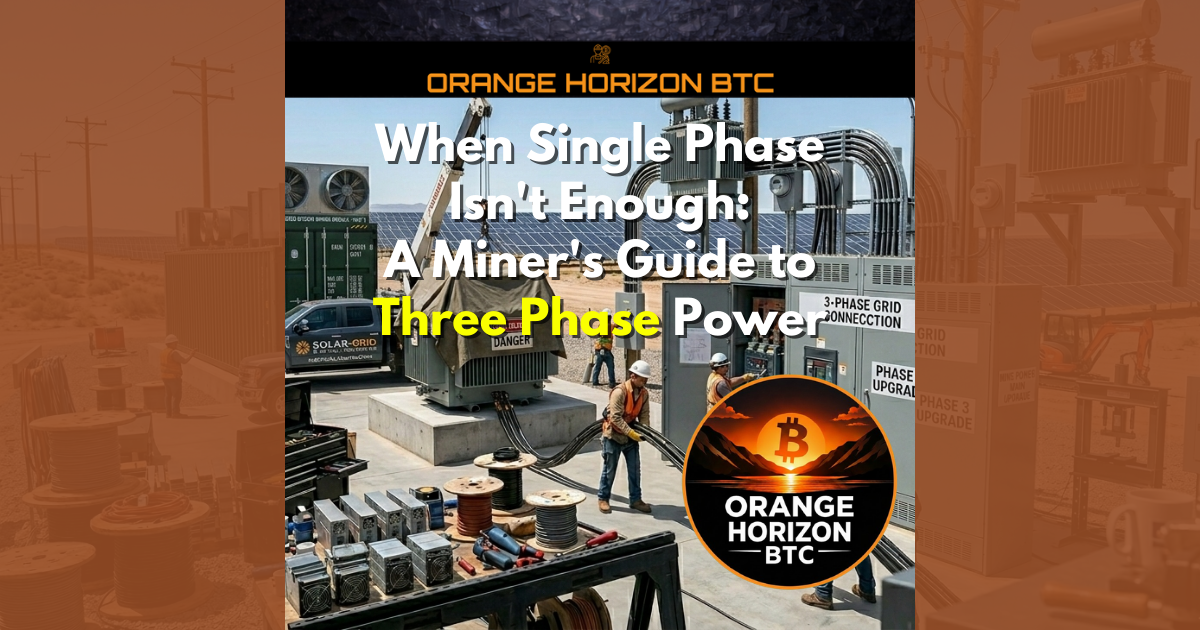
Single phase power is where most residential mining operations start and where a surprising number of them stall. Not because the economics stopped working, but because the infrastructure couldn’t keep up with the ambition. Upgrading to three phase is often the inflection point where a residential mining setup transitions into a higher capacity operation, but it’s not the only path.
Plenty of serious miners run profitable single phase setups by working within its limits intelligently. The question isn’t whether single phase is legitimate. It’s whether your specific growth plans have outgrown what it can deliver. If you’re still in the early stages and haven’t set up your first machine yet, my beginner’s guide to Bitcoin mining covers the basics before you get into scaling questions like this one.
This is the part of scaling that rarely shows up in profitability calculators. Electricity costs, hardware depreciation, and pool fees are easy to model. Transformer upgrades and utility interconnection applications are a different kind of homework and the process is more involved, more expensive, and more time consuming than some may acknowledge. This post is for the operator who’s starting to bump against that ceiling and wants to understand what’s actually involved before committing to the upgrade.
🟠 Single Phase vs Three Phase Power — What Actually Differs
Most North American homes have 120/240V split‑phase service (often casually called ‘single phase’). It delivers electricity as a single AC waveform, split into two legs 180° apart, providing 120V or 240V depending on how the circuit is configured. For everyday household use it handles the load comfortably.
For mining it works well up to a point and that point being wherever your panel capacity and existing household draws run out of headroom. Every installation is different, and what feels like plenty of capacity on paper can disappear quickly once you factor in HVAC, appliances, and the sustained load that miners pull around the clock.

Three phase power delivers electricity across three separate waves offset 120 degrees apart. In North America, three‑phase service is commonly 120/208V wye in many commercial buildings, or 277/480V in larger commercial/industrial facilities—with 480V being significantly higher than the 120/240V split-phase typical of residential service, and three‑phase service often being provisioned with substantially higher overall capacity (kVA) than a typical home service.
Note: 208V is common in commercial buildings and is slightly lower than 240V; 480V is the ‘big jump’ voltage that materially cuts current for a given power level.
The practical result is more consistent power delivery, higher capacity, and often better efficiency at scale, especially for distribution (higher voltage = lower current for the same kW) and for motor loads like large fans/pumps. Where a typical residential single phase service might give you 100 to 200 amps total, a three phase commercial service can deliver several times that capacity from a properly sized panel and transformer.
For miners the difference shows up in two ways. First, capacity. Three phase simply lets you run more hardware on the same infrastructure footprint. Second, efficiency. Larger motors and industrial equipment run more smoothly on three phase, which matters if you’re running serious cooling infrastructure alongside your miners — the shift toward advanced cooling systems is making this increasingly relevant.
It’s also worth noting that a growing category of newer generation ASICs are being designed to natively accept three phase input, meaning the efficiency advantage can extend to the miners themselves and not just the supporting infrastructure.
For the vast majority of current and legacy hardware running standard PSUs, an ASIC on single phase and the same ASIC on three phase produce identical hash rate. The upgrade is about removing the ceiling, not improving what’s already running beneath it.
🟠 When You Actually Need to Upgrade
The honest answer is that three phase becomes worth considering when your mining ambitions consistently exceed what your current infrastructure can safely and legally support. That looks different for every operator.
A few signals that you’re approaching that point: your electrician is telling you there’s no more room in the panel, you’re running dedicated circuits close to their rated capacity around the clock, or you’ve priced out the next phase of hardware expansion and realized the electrical work costs more than the miners themselves.
The sustained nature of mining load is what makes this calculation different from other high draw appliances. An electric dryer pulls heavy current but cycles on and off. Miners run at near full load continuously, 24 hours a day, every day. That sustained draw accelerates how quickly you approach the limits of your existing service and puts more stress on wiring, breakers, and panels that weren’t designed with that usage pattern in mind.
The decision isn’t purely about how many miners you’re running today. It’s about where you’re trying to be in 12 to 24 months. If the growth trajectory requires infrastructure that single phase can’t support, the earlier you understand the upgrade timeline and cost the better positioned you are to plan around it.
🟠 What the Upgrade Actually Involves
This is where the process tends to surprise people. A three phase upgrade isn’t just swapping out a panel. It typically involves multiple parties, permits, and timelines that stack on top of each other in ways that can stretch a project out considerably.

The process generally starts with your utility. Three phase service has to exist on or near your property for the upgrade to be straightforward.
In urban and suburban areas this is often available at the street.
In rural areas it may require the utility to extend three phase lines to your location, which adds significant cost and time to the project.
Getting a straight answer from your utility on availability, timeline, and cost is the first step and often the most frustrating one.
Once utility availability is confirmed, the work splits into two sides. The utility handles everything up to your meter — the transformer, the service entrance, the meter itself.
A licensed electrician handles everything from the meter inward — the new panel, the wiring, the circuits, and the permitting. Both sides need to coordinate, and delays on one side hold up the other.
Permits are not optional. A three phase upgrade is a significant electrical project and inspections are part of the process. Shortcuts here create liability problems and potential issues with insurance and property sales down the road. Factor permit timelines into your project schedule from the start.
The total timeline from initial utility inquiry to energized three phase service can range from a few weeks in straightforward urban situations to six months or more in rural locations where infrastructure work is required. Starting the process well before you need the capacity is the only way to avoid it becoming the bottleneck on your expansion plans.
🟠 The Cost Reality
Cost is the variable that stops most conversations about three phase upgrades before they start, and for good reason. The range is wide enough to make generalizations almost useless — but understanding what drives the cost helps set realistic expectations.
On the lower end, an operator in an urban or suburban area where three phase is already available at the street might be looking at an electrician bill for panel replacement and wiring plus utility connection fees. In favorable circumstances that can come in under $10,000. On the higher end, a rural property requiring the utility to run new three phase infrastructure to the site can push well past $50,000 before a single wire inside the building gets touched.
The variables that move the number most significantly are distance from existing three phase infrastructure, local utility fees and interconnection costs, the size of the new service being installed, the condition of existing building wiring, and local contractor rates.
Getting multiple quotes from both your utility and licensed electricians before committing is not optional — it’s the only way to understand what you’re actually working with. Electrical infrastructure is one of those costs that eat into a miner’s margins in ways that profitability calculators rarely capture.
One cost that’s easy to overlook is the equipment inside the building. Three phase panels, breakers, and wiring are more expensive than their single phase equivalents. PDUs and distribution equipment rated for three phase add to the total. Budget for the full system, not just the utility connection.
🟠 Cold Climate Considerations
Operators in cold climates face a unique set of variables when planning a three phase upgrade that aren’t relevant in warmer regions. Ground conditions, seasonal access, and utility scheduling all interact in ways that can extend timelines considerably.

Utility trench work and underground service installation becomes significantly more complex (and sometimes impossible) during frozen ground conditions. In regions with hard winters, a project that could be completed in weeks during summer might need to wait for spring thaw if it requires any ground disturbance. Planning upgrade timelines around seasonal windows is a practical reality in cold climates that warmer region operators don’t face.
On the other side of that equation, cold climate operators often have a natural advantage once the infrastructure is in place. Cooling overhead is dramatically lower during winter months, mining economics improve when ambient temperatures drop, and the heat output from a larger fleet becomes genuinely useful rather than a problem to manage.
Many of the same regions that offer cold climate advantages also overlap with abundant hydropower resources, which is part of why northern locations continue to attract mining operations. The infrastructure investment has a different payoff profile in a climate where several months of cold weather effectively subsidizes your cooling costs.
🟠 The ROI Calculation
Whether a three phase upgrade makes financial sense comes down to one question: does the additional mining capacity you can deploy justify the infrastructure cost over a reasonable time horizon?
The calculation starts with understanding what the upgrade actually unlocks. If moving to three phase allows you to double or triple your fleet, model the additional Bitcoin production at current difficulty and price, then stress test that against difficulty increases and price scenarios that aren’t favorable. The infrastructure cost needs to make sense across a range of conditions, not just the optimistic case. I walked through the full framework for how to model mining profitability in a separate essay if you want the detailed math.
Divide the total upgrade cost by the additional monthly revenue the expanded fleet generates. That gives you a rough payback period. Most operators want to see infrastructure investments recover within 18 to 36 months depending on their risk tolerance and confidence in the market. If the payback period stretches beyond that under realistic assumptions, the upgrade timeline may need to wait for either costs to come down or fleet economics to improve.
One factor worth including in the calculation is property value. A property with commercial grade three phase electrical service is genuinely more valuable than one without, particularly if it’s zoned in a way that supports industrial or commercial activity. That’s not a reason to upgrade on its own, but it’s a real asset that belongs in a complete analysis.
🟠 Conclusion
Scaling a Bitcoin mining operation is an infrastructure business as much as it is a hardware business. The machines are the visible part. The electrical capacity underneath them is what determines how far you can actually go.
Three phase power isn’t the right move for every operator at every stage. Plenty of serious mining operations run efficiently and profitably within the limits of single phase service. But for operators whose growth trajectory has genuinely outgrown what their current infrastructure supports, understanding the upgrade process (the timeline, the cost, the parties involved, and the variables that move the numbers) is the homework that precedes any serious expansion decision.
The miners that make it through multiple halving cycles tend to be the ones who treat infrastructure with the same analytical discipline they apply to hardware selection and electricity rates. The ceiling is real. The question is whether you’ve hit it yet, and whether the upgrade makes sense on your specific numbers.
Want to go deeper on the variables behind these numbers?
1️⃣ Read Dominant Variable Costs in Bitcoin Mining to know what actually eats your margins.
2️⃣ See what hardware operators are deploying in The New ASIC Landscape before you fill that new panel.
3️⃣ Read Mining Economics 101 for the full breakdown of what drives miner profitability.
▶️ Looking to upgrade your operation? Altair Technology, ASIC Marketplace, and OneMiners carry the hardware serious miners are actually running.
▶️ Need ASIC accessories? Amazon is a reliable source for surge protection, power cables, and other essentials that keep your operation running safely.
▶️ Need a hardware wallet? The Tangem wallet is a simple, card-format option for self-custody. Use code GPEBZY for 10% off.
▶️ New to mining? Here’s a hands-on guide to mining Bitcoin at home — from choosing hardware to realistic expectations for your first month.

testygrip17@walletofsatoshi.com

bc1qazjvrmdxv5d4xr482z72a6ev39du893lsakw0u
✅ Follow along on my socials:
🟠 X: @OrngeHorizonBTC
🔵 Bluesky: @orngehorizonbtc.bsky.social
🌐 Website: orangehorizonbtc.com



Leave a Reply