
💻 No hype. No price calls. Just honest analysis from an operator mining since 2019.
▫️ Review the free guide if you’re reassessing your mining setup.
▫️ Subscribe for free to get new insights in your inbox.
📑 Table of Contents
1. Introduction
2. Why Nuclear Fits Mining
3. Where It’s Happening
4. The Economics at Nuclear Rates
5. The Access Problem
6. Small Modular Reactors: What’s Coming
7. Nuclear as a Floor Setter for Mining Economics
8. What This Means for Operators
🟠 Introduction
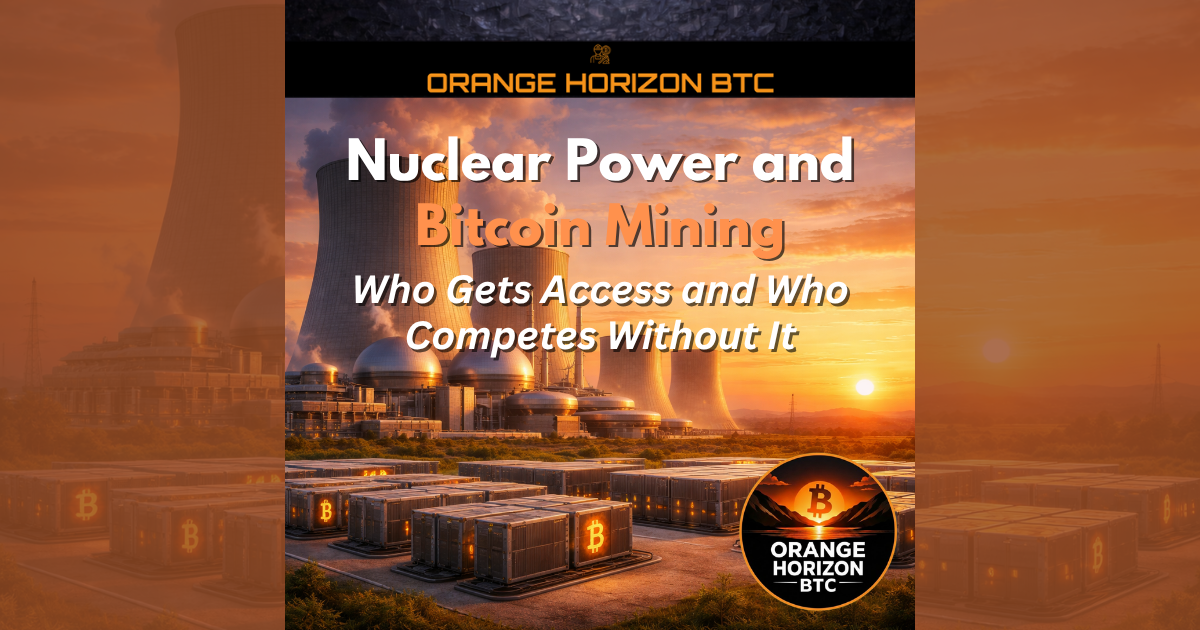
Nuclear energy is quietly becoming one of the most important power sources in Bitcoin mining.
Not because it’s new, but because it solves the exact problem miners have always faced: reliable, high-volume electricity at scale.
Between 2021 and 2025, nuclear’s share of Bitcoin mining’s energy mix grew from roughly 4% to around 10%. That shift didn’t happen by accident. It reflects a simple reality — when miners gain access to consistent, low-cost baseload power, the economics change immediately.
The catch is access.
Most miners will never plug into a nuclear plant. The few that do operate in a completely different cost environment, one that quietly sets the floor for the rest of the network.
This essay breaks down where nuclear-powered mining is actually happening, what it costs to mine 1 Bitcoin at nuclear rates, and why it matters even if you never get near a reactor.
🟠 Why Nuclear Fits Mining
Mining demands three things from a power source: low cost, constant output, and the ability to scale. Nuclear delivers all three, but only under specific conditions.

The defining characteristic is baseload. Nuclear plants operate at near full capacity, 24 hours a day, year-round. There is no intermittency to manage, no production cliffs to work around. For a mining operation where uptime directly determines revenue, that consistency is more valuable than a lower rate that isn’t always available.
This is where nuclear separates itself from most other energy sources. Solar and wind can be inexpensive, but they require overbuilding, storage, or curtailment strategies to maintain steady output. Nuclear does not. It provides continuous, high-density power by default.
At the same time, nuclear is carbon-free at the point of generation. That has limited impact on immediate operating costs, but it matters at the margins — particularly for regulatory exposure and public positioning. According to the Cambridge Centre for Alternative Finance, sustainable sources now account for over half of Bitcoin mining’s energy mix, with nuclear making up a growing share.
But the constraint is where the real story sits.
Nuclear power is not inherently cheap. It becomes cheap only when accessed correctly — typically through direct co-location or long-term power purchase agreements. The headline rates often cited in mining discussions, such as ~$0.02/kWh, exist because operations are built behind the meter, drawing power directly from the source before it reaches the grid.
That is not a market rate. It is an infrastructure advantage.
Once nuclear power enters the grid, it is blended with every other source and priced accordingly. At that point, any unique cost advantage largely disappears.
So the question is not whether nuclear fits mining. It does.
The question is who can actually access it.
🟠 Where It’s Happening
Nuclear-powered Bitcoin mining is not theoretical. It has already been deployed at industrial scale, with the clearest example in Pennsylvania.
In 2021, TeraWulf partnered with Talen Energy to develop the Nautilus Cryptomine, built adjacent to the Susquehanna nuclear generating station. The facility was designed as a behind-the-meter operation, drawing power directly from the plant before it entered the grid.
That structure is what made the economics work.
Nautilus secured a fixed power rate of approximately $0.02 per kilowatt-hour for five years — among the lowest contracted energy costs in the mining sector at the time. By early 2023, the site had scaled to roughly 16,000 miners, producing close to 2 EH/s across 50 megawatts of capacity, with expansion potential to 100 megawatts.

For a period, it demonstrated exactly what nuclear-powered mining could offer: continuous output, stable input costs, and no emissions at the point of generation.
The shift came from outside mining.
In late 2024, Talen Energy acquired TeraWulf’s 25% stake in Nautilus for $92 million. The move followed a separate transaction in which Talen sold an adjacent 960-megawatt data center campus to Amazon Web Services for $650 million.
The implication is straightforward. Nuclear-adjacent power and infrastructure commanded a higher value in hyperscale computing than in Bitcoin mining. TeraWulf redirected capital toward AI and high-performance computing at its Lake Mariner site, while Talen consolidated control of the nuclear-connected asset.
This is the current dynamic in its clearest form. Mining validated the model. Larger buyers are now competing for the same power.
Outside the United States, activity is more limited but still relevant. Électricité de France has explored allocating surplus nuclear generation to Bitcoin mining — a logical extension in a country where nuclear provides the majority of electricity. These efforts remain exploratory and have not reached comparable scale.
At the far edge of the spectrum is the Zaporizhzhia Nuclear Power Plant. Following its capture during the Russian invasion of Ukraine, Russian officials have intermittently raised the possibility of using the site for cryptocurrency mining. The plant has operated at reduced or suspended capacity since 2022, and any mining deployment remains speculative. Still, the fact that nuclear infrastructure is being discussed in this context — even geopolitically — reflects how the conversation has shifted.
Across all of these cases, one constraint is consistent: scale.
Every credible nuclear-powered mining operation is institutional. Access requires physical co-location or long-term agreements with power producers. There are no small operators plugging into reactor output, and there is no open market for nuclear-priced electricity.
Which leads to the only question that matters for most miners: what do the economics look like when access is secured?
🟠 The Economics at Nuclear Rates
In a previous essay, I broke down the cost to mine 1 Bitcoin across three electricity tiers using an Antminer S23 air-cooled unit running at roughly 11 J/TH, with a daily consumption of about 84 kWh. Those scenarios assumed power rates of $0.05, $0.10, and $0.15 per kilowatt-hour — representing industrial, mixed-use, and residential environments.

Nuclear resets that baseline.
At $0.02 per kilowatt-hour — the rate achieved through behind-the-meter access at Susquehanna — the daily electricity cost for the same machine drops to approximately $1.68 USD. Using the same illustrative production rate of ~0.00014 BTC per day under recent network conditions, the electricity-only cost to mine 1 Bitcoin falls to roughly $12,000 USD.
Set against the previous tiers:
🔸 At $0.02/kWh: ~$12,000 USD per BTC.
🔸 At $0.05/kWh: ~$30,000 USD per BTC.
🔸 At $0.10/kWh: ~$60,000 USD per BTC.
🔸 At $0.15/kWh: ~$90,000 USD per BTC.
This is not a marginal improvement. It is a different cost structure.
Cheap power does more than reduce cost per coin. It changes how an operation behaves.
At $0.02/kWh, hardware that would be uneconomical elsewhere remains viable. Older-generation ASICs in the 20–25 J/TH range — machines many operators would have already retired — can continue producing positive daily returns. That extends hardware lifecycles, slows depreciation, and reduces the urgency to upgrade with each new generation.
It also moves the shutdown threshold.
Every operation has a point where running machines no longer makes sense — where the cost to produce a Bitcoin exceeds what the market will pay. At higher electricity rates, that threshold sits close to market price during downturns. At nuclear rates, it moves significantly lower. Bitcoin’s price would need to fall much further before shutting down becomes rational.
That gap is structural.
And this is where the impact extends beyond the operators who have access.
When part of the network can mine profitably at costs far below the average, they do not power down during bear markets. They continue hashing. That persistent hashrate keeps network difficulty elevated even as prices decline, compressing margins for everyone else.
At that point, you are no longer competing against your local electricity rate. You are competing against someone else’s.
This is why nuclear matters, even if you never access it directly.
It sets the floor.
🟠 The Access Problem
The natural response to nuclear economics is straightforward: if the advantage is this large, why isn’t every miner pursuing it?
Because access is not a market. It is a position.
Nuclear-priced electricity is only available through co-location or long-term agreements with power producers. Both require scale, capital, and timing that most operators do not have. This is not something you can source. It is something you build into.
The behind-the-meter model that defined Nautilus depended on exactly that — siting a mining facility directly adjacent to a nuclear plant with a dedicated connection to its output. That is as much a real estate and infrastructure decision as it is an energy one. It involves permitting, utility coordination, and development timelines measured in years.

And the number of viable sites is limited.
That constraint is tightening as a larger buyer enters the market.
Companies like Amazon Web Services, Microsoft, Google, and Meta are actively securing nuclear capacity through long-term power purchase agreements. These are not exploratory moves. They are multi-decade commitments tied to the buildout of artificial intelligence infrastructure.
Recent transactions make the shift visible. Talen Energy sold a nuclear-adjacent data center campus to Amazon Web Services for $650 million. Microsoft has backed TerraPower, while Meta and Google have pursued long-term nuclear agreements through utilities such as Constellation Energy.
The difference comes down to revenue certainty.
A hyperscale data center can commit to a 10–15 year contract at a fixed rate. Its demand is stable and forecastable. A mining operation cannot offer the same profile. Its revenue depends on Bitcoin price, network difficulty, and block rewards — all of which move.
From the perspective of a nuclear operator, this is a straightforward allocation decision. Capital flows toward the most predictable return.
This is not a flaw in mining. It is how infrastructure markets function under competition.
Miners were early in identifying nuclear as a viable power source for compute. They proved the model could work. But proving a model does not secure long-term access to it.
The Nautilus project reflects that dynamic clearly. TeraWulf built and operated the facility under favorable terms, then exited as the underlying asset attracted higher-value demand.
The open question is what happens next.
If nuclear capacity remains constrained, access will continue to concentrate among the largest and most capitalized buyers. If new capacity expands meaningfully, there may be room for both industries.
That expansion depends on technologies that are still in development.
🟠 Small Modular Reactors: What’s Coming

If the access problem is defined by the scale and rigidity of existing nuclear infrastructure, small modular reactors (SMRs) are an attempt to change that constraint.
SMRs are smaller by design. Where conventional reactors typically generate on the order of 1,000 megawatts, SMRs are generally designed in the 50 to 300 megawatt range. They are intended to be factory-built, standardized, and deployed in modular units — reducing construction timelines and, in theory, lowering capital complexity.
For energy-intensive computing, the appeal is straightforward: co-location without reliance on legacy plants.
Instead of competing for access to existing nuclear infrastructure, operators could deploy generation closer to the point of consumption. Industrial zones, remote energy sites, and purpose-built computing campuses are the primary targets.
SMR development is active but uneven. NuScale Power earned the first U.S. design certification, though its Idaho project was canceled due to cost escalation. TerraPower, backed by Bill Gates and Microsoft, is building a demonstration reactor in Wyoming, aiming for late 2020s deployment. Other SMR projects are underway in Canada, the U.K., and South Korea, though timelines remain multi-year.
For mining, the relevance is conditional.
If SMRs reach commercial deployment at projected costs, they could open a new path to nuclear-adjacent power without requiring proximity to a legacy plant or long-term utility contracts. That would expand access beyond the current institutional bottleneck and potentially bring nuclear-tier economics within reach of large-scale operators.
But that outcome is not established.
No SMR is operating at commercial scale today. Regulatory timelines remain slow, capital costs are uncertain, and early projects have already shown that overruns are likely in first deployments.
The practical view is simple.
SMRs are the most credible path to expanding nuclear access. They are also unproven at scale and several years from meaningful impact.
For an operator making decisions today, they belong on the radar — not in the business plan.
⚠️ Insight for operators: SMRs are promising on paper, but your near-term strategy should not assume access. Treat them as a long-term radar point, not an actionable path today.
🟠 Nuclear as a Floor Setter for Mining Economics

Most miners will never operate at nuclear rates. That does not make nuclear irrelevant. It makes it one of the most important variables they do not directly control.
In Bitcoin mining, the cost floor is set by the lowest-cost producer. That role has shifted over time — from Chinese hydro prior to 2021, to stranded gas and industrial-scale hydro in North America, and now increasingly to nuclear-adjacent operations with structurally lower input costs.
At ~$0.02/kWh, electricity-only breakeven sits near $12,000 USD per Bitcoin under recent conditions. Operators at that level remain profitable through price ranges that force higher-cost miners offline. They do not shut down during drawdowns. They continue hashing.
The network-level effect follows directly.
Hashrate that does not leave during downturns keeps difficulty elevated. Elevated difficulty reduces output per machine across the network. At that point, a miner paying $0.10 or $0.15/kWh is not only dealing with their own cost structure — they are operating against a difficulty environment sustained by producers with far lower costs.
This dynamic is not new. Low-cost hydro has played this role before. What nuclear changes is consistency.
Hydro output can vary seasonally with water availability (in regulated systems prices for operators remain stable through contracts). Nuclear, by contrast, delivers consistent output year-round, so the cost floor it establishes is both predictable and persistent — a structural pressure on the network that doesn’t rely on seasonal flows.
There is also a second-order effect on hardware.
When power costs are low enough, older and less efficient ASICs remain viable. Instead of being retired, they stay online. That extends the effective lifespan of hardware across the network and slows the natural decline in hashrate during weaker market conditions — a process that has historically provided relief to higher-cost operators.
The result is compression.
Nuclear-tier mining does not eliminate higher-cost operators, but it narrows the range in which they can operate profitably. Margins become thinner, shutdown thresholds move closer, and recovery periods shorten.
Even without direct access, the influence is unavoidable.
The floor is already being set.
🟠 What This Means for Operators
None of this changes what you do tomorrow. It should change how you understand your position.
If you are a home miner running one or two machines on residential power, nuclear is not a viable path. The infrastructure, capital, and access constraints exist at a scale far beyond that environment. Acknowledging that is not limiting — it is clarifying. Your advantage comes from elsewhere: low or subsidized rates, heat reuse, tax structure, or a long-term accumulation approach that does not depend on short-term margins.

For mid-scale operators running containerized setups or small facilities, the impact is indirect but persistent. You are not competing for nuclear power. You are operating within a difficulty environment that nuclear-tier miners help sustain. That means structurally tighter margins and less relief during downturns. Planning for efficiency and durability matters more than assuming conditions will ease.
At industrial scale, nuclear and SMR developments warrant attention. Not because access is immediate, but because early access defines long-term positioning. The Nautilus example is instructive: favorable terms were secured early, and the window narrowed as larger capital entered.
Across all levels, the conclusion is consistent.
You do not need nuclear power to mine profitably. But you do need to account for it. Somewhere on the network, operators are producing Bitcoin at a fraction of your cost — and they are not turning off.
That reality shapes your constraints.
Long-term survival does not come from finding the absolute lowest power cost. It comes from building an operation that remains viable in a network where someone else already has.
Want to go deeper on the economics behind these numbers?
1️⃣ Read How Much Does It Cost to Mine 1 Bitcoin? for the full cost breakdown at three electricity tiers.
2️⃣ Read Follow the Water for how hydro power shapes the geography of mining.
3️⃣ Read Mining Economics 101 for the full profitability framework.
▶️ Looking to upgrade your operation? Altair Technology, ASIC Marketplace, and OneMiners carry the hardware serious miners are actually running.
▶️ Need ASIC accessories? Amazon is a reliable source for surge protection, power cables, and other essentials that keep your operation running safely.
▶️ Need a hardware wallet? The Tangem wallet is a simple, card-format option for self-custody. Use code GPEBZY for 10% off.
▶️ New to mining? Here’s a hands-on guide to mining Bitcoin at home — from choosing hardware to realistic expectations for your first month.

testygrip17@walletofsatoshi.com

bc1qazjvrmdxv5d4xr482z72a6ev39du893lsakw0u
✅ Follow along on my socials:
🔸 🐦 X: @OrngeHorizonBTC
🔸 🦋 Bluesky: @orngehorizonbtc.bsky.social
🔸 🌐 Website: orangehorizonbtc.com


Leave a Reply